From Tirano to 2,253 m: the view from the Bernina train
The train ride is the reason for the whole day, and it lasts about two to two and a half hours. It climbs from the vineyards of Tirano to a lake above the tree line, then drops into the Engadin. Below, the sights in order from the Italian end, and how to see them well.
A line built to climb without cogs
The Bernina line of the Rhaetian Railway opened in 1910 and runs from Tirano in Italy over the Bernina pass to St. Moritz. It counts among the steepest railways in the world that climb on plain wheels, with no rack in the middle of the track.
Frigerio Viaggi's listing counts 55 tunnels and 196 bridges, with gradients up to 70 per mille. Together with the Albula line, the route has been a UNESCO World Heritage site since 2008.
The tours ride it in both directions. TaoTravel and Frigerio usually go down from St. Moritz to Tirano, as does Autostradale. Milano Art Discovery and LUCAfromITALY ride up from Tirano, so the order flips but the sights stay the same.
Tirano and the spiral at Brusio
Tirano sits at about 430 m in the Valtellina, an Italian wine valley of terraced slopes. Frigerio's group stops briefly here at the sanctuary of the Madonna and the old center before the coach heads home.
Soon after the Swiss border the train reaches the Brusio spiral viaduct. The track curls round a full circle of stone arches and passes under itself to gain height in a narrow valley.
Most coach tours that end in Tirano give only a short stop there, ten minutes on TaoTravel. LUCAfromITALY gives about an hour for lunch before boarding, the longest look at the town among the five.
From inside the train the spiral is hard to grasp, because you are part of it. Watch for the moment the carriages ahead appear beside you on the curve, which is the best clue that you are on the loop.
Poschiavo and the lower valley
Above Brusio the line follows the Val Poschiavo, an Italian-speaking valley inside Switzerland. Meadows and forest cover the slopes above the houses, and the train runs close to them.
Poschiavo is the main town of the valley, with a square of old stone buildings. The train halts briefly but tours do not get off, so this stretch is for looking rather than photographing at length.
Beyond the town the line skirts the small lake of Poschiavo. The valley widens here, and the water reflects the slopes on a calm day. Move to the lake side of the carriage here, since the shore runs right beside the track.
The valley floor stays green for most of the year. That makes this lower part a calm warm-up before the big climb, and a good time to settle into your seat and open a window if your train allows it.
Alp Grüm and the Palü glacier
Above the forest the line climbs in tight bends to Alp Grüm, a small station perched over the valley. From here the Palü glacier hangs across the slope opposite, with the lake of Palü below it.
Milano Art Discovery is the one tour on this site that gets off here. Its group takes a short walk on marked trails before boarding a later train, so you see the glacier without a window in the way.
A walk at Alp Grüm, then on to the top
Milano Art Discovery stops at Alp Grüm for the Palü glacier and scores 4.8 from 4,900+ reviews. It is listed on GetYourGuide only.
The walk is gentle, but the station sits high and the wind can be cold. Wear shoes with grip, since the path may be wet or snowy outside summer.
Lago Bianco and the top at 2,253 m
Past Alp Grüm the train reaches the open plateau of the pass. Lago Bianco stretches beside the track. It is milky turquoise in summer and white under snow and ice in winter.
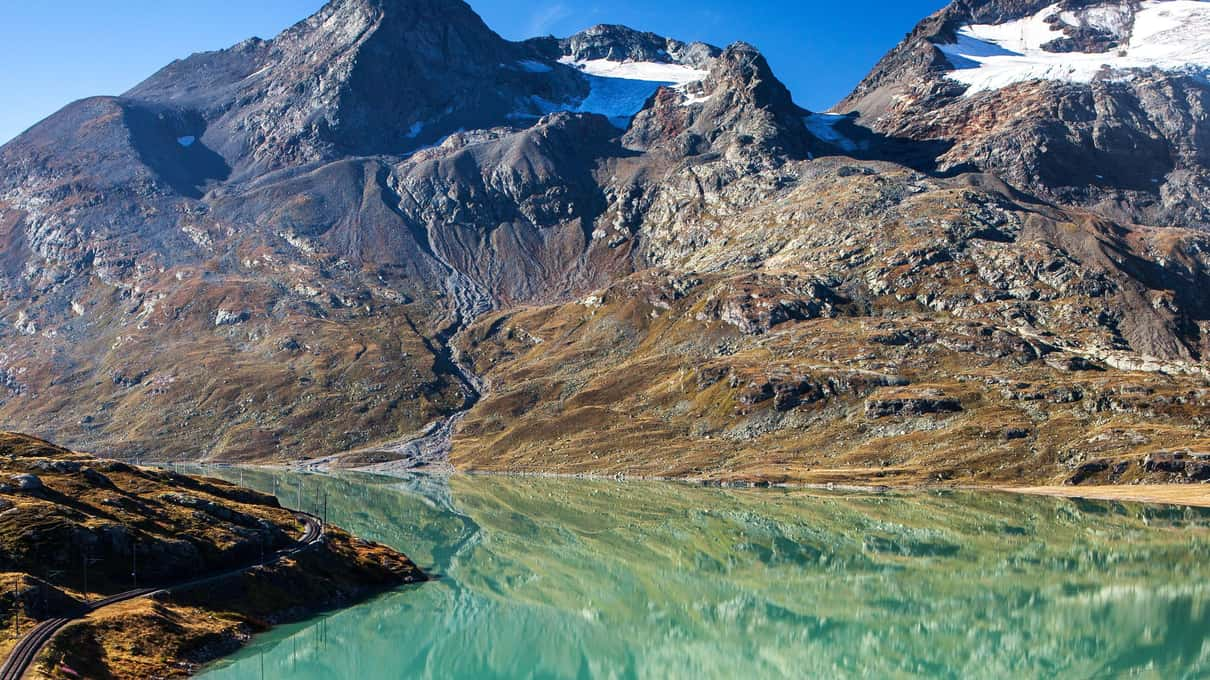
The highest point of the line is near the Ospizio Bernina station, at about 2,253 m (7,392 ft). Above the tree line there is only rock and water, and it feels far colder than the valley you left.
That height is why our list of what to bring across the border starts with a warm layer even in summer. The air also feels thinner, and the listings warn people prone to altitude sickness.
Down past Montebello and Morteratsch
On the Engadin side the line passes the Bernina Diavolezza station, the starting point of Frigerio's optional lunch on the mountain. Soon after, the train swings through the Montebello curve.
The curve opens a view up the valley to the Morteratsch glacier and the peaks of the Bernina group. It lasts a minute or two, so have the camera ready before the bend.
From there the track descends through larch forest to Pontresina and on to St. Moritz. For the town itself, our guide to your time in St. Moritz covers what fits into a short stop.
Which side to sit on
Reviewers disagree. One swears by the left side and another by the right. Both are partly correct because the line twists so often that the view swaps sides many times.
On the red regional train in 2nd class the windows open, so you can move to whichever side has the view. That freedom is one of the strongest arguments for the red train, as our comparison of the panoramic car and the red train explains.
In Frigerio's panoramic car the seats are guaranteed but not assigned in advance, and the glass roof shows both sides at once. Reflections are the trade-off, since those windows do not open.
Clouds can hide the glaciers and peaks on any day, and snow changes the look of the whole pass. No tour can promise the views, so treat a clear day as luck. Our page on the best season to go covers how the light shifts through the year.
For a cheaper way in, TaoTravel's day at ~$155 rides the same line in the red train with windows that open. The price comparison sets all five tours side by side.